Friday, September 14, 2012

Black Hills National Forest

By Claire
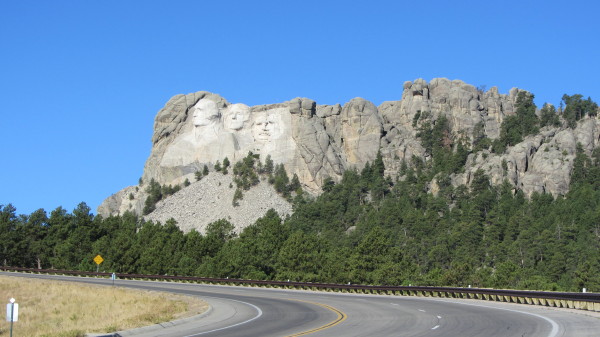
Another gorgeous day in beautiful South Dakota.  We're staying in Rapid City, a good base for the things we wanted to see.  I was excited about our drive through the Black Hills and my first sighting of Mt. Rushmore.  I've always felt it was one of those things you have to see before you die.  We were so lucky to have perfect weather and I was happy to find out in my research that mornings are the best time to arrive since the memorial faces east.  Not only that, arriving at 8:30, we beat most of the crowds.  Except there really aren't any crowds at this time of year.  That has been one of the nicest things about this trip.


On the road to Mt. Rushmore

First sighting from the road
 
At the entrance 

It's everywhere

We started with a fascinating video about the construction of Mt. Rushmore and information about Gutzon Borglum, the sculptor of the memorial.  It took years of planning and building models plus dynamiting to create this masterpiece.  He changed the design nine times.  Men were hoisted down in wooden seats with pulleys; there was no protection for their ears from the blasts or their lungs from the dust.  Years later when they started wearing dust masks, the men would cut a hole in them so they could smoke.  The good news is, there were no fatalities.


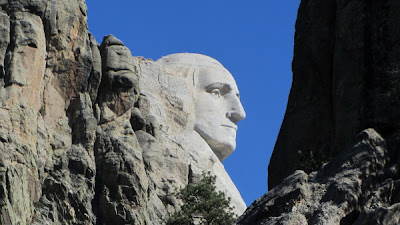
We walked the trail to the Sculpture Workshop and found the best view of all.  We also met a Dutch couple who took our picture and then proceeded to chat with them for about 15 minutes. 


This one is almost my favorite, taken as we were leaving, driving on to our next site.


But wait!  Here's the rear of Mt. Rushmore!


We drove through the Black Hills noticing a sign that warned "Danger! Large Wildlife on Road."  He isn't that large and didn't look too dangerous but I didn't get out of the car to take this photo of a mountain goat.


In South Dakota, they are referred to as Buffalo.  We saw too many to photograph them all.


Next on our agenda was the Crazy Horse Memorial.  I knew nothing about it and therefore had no expectations. I didn't even know it was another carving out of rock.  What a surprise!  


The sculpture was created by Korczak Ziolkowski, a Polish American from Boston who had been an assistant on Mt. Rushmore.  Work was begun in 1948 and continues to this day.  He was completely self-taught and never took a formal lesson in art, sculpture, architecture or engineering.  Since Korczak's death in 1982, his wife, with seven of their children, working in concert with the Crazy Horse Memorial Foundation Board of Directors, has directed the work which continues to see exciting progress being made with each passing year.  We saw one of the daughters on the deck of the restaurant complex dead-heading flowers, checking on things and generally being useful.  The future of the Crazy Horse Visitor Complex is an Indian Museum of North America (well on its way), Indian University of North America (they have had two classes of students), and a Medical Training Center.  The project is financed primarily from an admission fee and donations. They decline to accept any government funding, partly out of concern that the project would later be dropped.


This  is the model of what the finished work will look like. To give an idea of the scale of this monumental work, the entire Mount Rushmore project--that's 4 giant Presidential busts--would fit within the completed head of Chief Crazy Horse!


There is no documented photograph of Crazy Horse.  This model is a composite likeness created by Korczak from "word pictures" given in the 1940s by old Indians who had known Crazy Horse in the few years that he lived from 1843-1877.


Leaving Crazy Horse, we  continued our scenic drive, enjoying the wildlife around us, especially one that gracefully walked across the road in front of us.

 Pronghorn Antelope

These adorable prairie dogs were popping up all over the place.

No wildlife, just a nice view.
  

Chuck's final plan for the day was a visit to Wind Cave National Park and a tour of some of the cave.  We picnicked along the way and made it just in time for the 2:30 tour.  Our tour guide, Tiffany, is from north eastern Nebraska.  She studies meteorology and told me that Nebraska has 90-100% humidity.  No, we didn't crawl down that hole.


This is one of the World's largest cave complexes, having 95% of the world's boxwork--a feature created from limestone cracks filling with gypsum and then having (naturally forming) carbolic acid eat away the softer limestone, leaving a honeycomb-like structure: boxwork. The wind coming out of the cave can reach 70mph. Wind studies have allowed scientists to determine that only about 5-10% of the cave has been discovered/explored so far. Chuck was impressed--and a little nervous--that we walked over and looked up along one of the area's geological faults.


An exciting day, especially when you spot signs like "Reptile Garden. This ain't no petting zoo."

My lands are where my dead lie buried. ~ Crazy Horse

My fellow chiefs and I would like the white man to know the red man has great heroes, too. ~ Chief Henry Standing Bear (in his 1939 invitation to Korczak to carve Crazy Horse Memorial)

Thursday, September 13, 2012

Ambling Across America

By Claire
Today really was a road trip.  We motored out of Montana, wound our way through Wyoming and slid into South Dakota.  We are tired but exhilarated by all that we saw.  The weather was a perfect 70° as Chuck began the day at the wheel while I sat in the co-pilot seat/office setting up the GPS (Vicky) to take us to our next lodging location while simultaneously adding our first site into my iPhone GPS.  I also use my iPhone to get information about the sites that Chuck and I planned for our day back when I was working on Wyoming and he was working on South Dakota.  To make it more enjoyable, we switch places every hour or so.  The mornings have been cold and I am really appreciating our seat warmers.

On the road in Wyoming once again

The other side of the road

Our first stop was The Devil's Tower in Wyoming, a huge monolith resembling a colossal stone tree stump, rising 867 feet from its base and 1,267 feet above the Belle Fourche River.  The 1.5 acre top has a growth of sagebrush and grass and the almost perpendicular sides are fluted columns.  It was the first National Monument.


It took us almost 4 hours driving back roads to find this place so once we were back on the interstate we stopped at the first rest stop we came upon for a picnic lunch.


And speaking of back roads and interstates, they are almost identical.  The interstate has two lanes and there are very few cars.  The back roads have two lanes and no other cars.  We were cruising down 14a when 8 identical Cruise America RVs flew past, one after the other, all sporting German flags flapping on the side.  I guess it was a reunion. How fun!  I think those were the only vehicles we saw for an hour. 

Soon we left the prairie of Wyoming to discover the gorgeous sites of South Dakota.  We headed for Spearfish Canyon, a Scenic Byway.  It sure was.


Our first order of business was the trail to Roughlock Falls.  Only a mile each way, it was so beautiful and different from my usual hikes; so many different trees and plants.  It was warm with just the tiniest breeze caressing my face and arms.


Someone left an autumn bouquet on one of the many benches along the way.


Nice waterfall


One of the things I did during my turn in the "office" was to check out the info on Spearfish Canyon.  Using my iPhone to look up the area on Google, I found out about two hikes.  The one to the falls and another one called The '76 which was described as a steep mile and a half hike to the canyon rim with one section, about half a mile, 1,000 feet in elevation gain.  We found the trail head across the road from the first hike and off we went.  It wasn't too bad until we came to a sign that said Steep Trail Ahead.  They weren't kidding.  Huffing and puffing, we made it to the top.  Eureka!


Resting along the trail

View from the top


That turquoise roof is next to the parking lot where our car is parked.


Hiking back down, we walked through a fern forest, all of them yellow but looking like they would come back to life in the spring.


Our final stop was in Deadwood, SD.  It was at the end of the Scenic Byway after the town of Lead, a gold town and twin city of Deadwood.  Some of you might have watched the HBO series, Deadwood, a few years ago.  We couldn't pass this by.  I was so afraid it would be a tacky tourist place like Tombstone, AZ or Virginia City, NV.  There were a few tourist traps but mostly it was just a town of a little over 3,000 people going about their business.  We headed for the cemetery to find the grave of Wild Bill Hickock.  It cost us a dollar a piece.

We found Wild Bill's grave right away.  He was only 39 when he died, shot by a former buffalo hunter named Jack McCall (better known as "Broken Nose Jack"). 


Calamity Jane's final request was that she be buried next to her friend, Wild Bill.


 Wild Bill

The Cemetery
  

Looking down on Deadwood


Seth Bullock, town sheriff

Seth was a friend of Teddy Roosevelt and had a memorial built to him on Teddy Roosevelt Mountain.  He requested that he be buried above the cemetery and facing the mountain.  His grave is a steep hike 750 feet above the cemetery. 

Beautiful home in Deadwood

Neighborhood in Deadwood

 By now it was 4:30 and we were ready to be "home" and relaxing.  We drove the last 25 miles to Rapid City, our location for the next 2 nights and with a recommendation and 10% off card from the hotel receptionist, we raced over to the Texas Roadhouse.  I was starving and as usual, my eyes were bigger than my stomach.  I felt like exploding when we left.  I have to say, the service was amazing and when they asked whether we'd been there before (no), we were offered a Cactus Flower starter plate as first timers.  We started with margaritas.


 Cactus Flower (onion rings)

 My side dish of homemade chili (delicious)

My sirloin kebab with fabulous grilled veggies and rice

 Chuck's 8 oz. sirloin with sweet potato side

The end to a beautiful day.  More tomorrow.


We do not see nature with our eyes, but with our understandings and our hearts. ~ William Hazlitt


Wednesday, September 12, 2012

Little Big Horn National Monument

By Chuck

I had always wanted to visit the site of Custer's Last Stand. Today was the day. Decades ago a decision was reached to honor all of the fallen heroes of the battle and the name became that of the site rather than that of one of the combatants. I found myself strangely moved by our guide's account of the actions in the battle and the horrible slaughter. It is especially poignant when considered against the backdrop of ongoing tensions between Native Americans and the U.S. Government. I recall going to a lecture by Nobel Laureate Linus Pauling who was lobbying for a nuclear armistice between the USSR and the U.S. in the early 60's. Young Republicans were picketing, asserting that Russia could not be trusted to keep its word; Pauling responded that the U.S. had signed over 1,000 treaties with Native Americans and had broken them all.

A brief background to the Battle of the Little Bighorn: The U.S. signed a treaty with (some of the) Native Americans in the area in 1868--including Lakota and Cheyenne. The Black Hills of South Dakota were sacred to the Lakota and guaranteed under the Treaty. But, the U.S. had a recession, gold was discovered in the Hills, and thousands of gold seekers flocked to the Native American grounds. The army tried to keep them out, but failed. The government tried to buy the land from the Native Americans in an attempt to avoid further confrontations; but, the Indians refused to sell their sacred grounds. Our guide told us that the proffered funds are still sitting in a bank account, gathering interest and that they are now worth $1.3 billion; but, the Native Americans refuse to accede to the sale of their land.

In response to the abrogation of the treaty, some Native Americans took up arms and left their reservations. In December, 1875, the commissioner of Indian Affairs ordered the tribes to return to their reservations by January 31, 1876 or be treated as hostiles by the military force. The Indians did not respond, and the Army sent Custer and others to enforce the order. This overlooks the extreme difficulty of moving encampments in the dead of winter in Montana and the fact that Indians calculate time by the sun and moon, not by timepieces and Western calendars.

The result was the infamous Battle of Little Bighorn.

The Little Bighorn Battlefield

There are grave markers for both Native Americans and U.S. Soldiers in the battle areas, marking the spots where warriors fell. Red markers for Native Americans, white for U.S. soldiers.


Our excellent tour guide, Rose

Reading the AAA Tour Guide, Claire discovered that there was a guided bus tour of the Battlefield, conducted by Native Americans. Better still, the price for Seniors was only $5.

Even the poor horses deserved a memorial.  Many of the soldiers shot their horses and used them as cover.


This is a shot of the National Cemetery, taken from the path to the Soldiers' Memorial. The tipi is obvious; the building to the right is the Visitor Center and Museum. They showed an excellent film on the battle and the events leading up to it.


A few of the many markers indicating where soldiers fell scattered throughout the area.


The soldiers' memorial plaque

The monument to the U.S. Soldiers at the Battle of the Little Bighorn

Markers for Last Stand Hill, where George Armstrong Custer and the last of his men fell on July 25, 1876--the Centennial of our Nation's birth.


This marker purports to show where Custer actually fell. All of the testimony regarding the Last Stand is from Native Americans, as Custer's party was entirely wiped out.


This Native American victory was short-lived; it was their last  win and signaled the final stage of the Indian Wars, which had gone on for decades.


The National Cemetery at Little Bighorn National Monument. There are two soldiers here from the battle; in addition, veterans from the Spanish American War, World War I, World War II, The Korean War and Vietnam are buried here.


We think Ben Foster would be great in the role of George Armstrong Custer.  What do you think?


Finally arriving at our motel, a Rodeway Inn, we immediately decided to try their $2.50 Margaritas in the Casino next door. It really hit the spot.


By the way, I think I neglected to mention that there is no sales tax in Montana--a pleasant surprise for us. But, for locals, this means that government is supported by property taxes--a sore point.

The muffled drum's sad roll has beat
The soldier's last tatoo.
No more on life's parade shall meet
That brave and fallen few.
   ~ Memorial Sign at Little Bighorn National Cemetery