Sunday, October 28, 2012

Flamingo, Florida

By Claire

We were in the southernmost part of the Everglades today, Flamingo.  Alas, no Flamingos.  Those that are left are in the Caribbean and any that you see in Florida are most likely escaped pets.

We decided on a boat tour, with the hope of seeing more wildlife.  This area is the only place in the world where Alligators and Crocodiles coexist.  Apparently, they live quite well together.  I learned that Alligators live in fresh water but can live in brackish (salty) water for up to three weeks. Crocodiles live in salt water but can exist in brackish water as well.

We stopped at one of the many ponds along the way and came upon hundreds of birds of all kinds.  We also discovered mosquitoes for a brief moment.  Turns out we should stay out of grass and shade. 


First up, the Wood Stork.  They have been on the endangered species list since 1984 so we were lucky to see one.  Walking slowly forward, the stork sweeps its submerged bill from side to side.  Touching its prey, mostly small fish, the bill snaps shut with a 25-millisecond reflex action, the fastest reflex known for vertebrate species.   This guy was beautiful in flight.


An almost bigger thrill was seeing this Roseate Spoonbill. They are gorgeous flying through the air, almost lit from beneath in red.


We arrived at the Marina in Flamingo and were reminded that cars can be damaged by the local thugs in town--Black Vultures.  They even have tarps available to cover your car.  They go for the rubber parts on the car, but I guess the tires are off limits--the tarps do not cover them.


Here's a pack already moving in for the kill.


Our boat for the day.  We had a wonderful guide, Bill, and his assistant Sheena.  It was smooth all the way.


We were lucky that there were only 10 of us--we had front row seats.


I felt as if we were heading into the Amazon--maybe because of reading State of Wonder--a great story that takes place there.


And there he was, right on the river bank sunning himself--an alligator.


There are three kinds of Mangroves:  Red, Black and White.  These are Red Mangroves.  They grow closest to open water and have multiple prop roots, which may help to stabilize the soil around its roots.  Our guide told us that the roots are so strong, they are hurricane proof.


 Osprey

 
Great Blue Heron.  We saw many of these guys, as well as their younger brothers.  You can spot the young, completely white ones by their lime-colored legs.


After our boat trip, we drove back to visitor center at the park entrance at Royal Palm so we could walk the Gumbo Limbo trail.  These strange things are growing everywhere in this orange soup of detritus that feeds the plants.
 

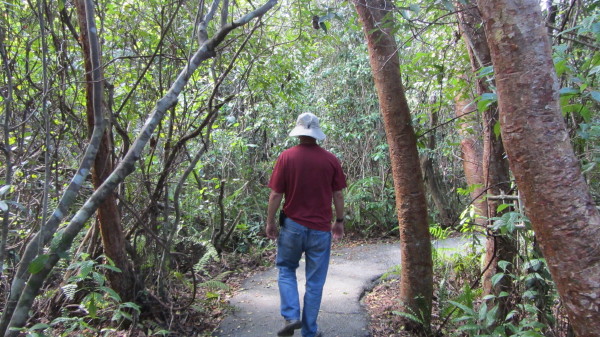
This trail is closest to being a jungle.


This is a Gumbo-Limbo tree.  Even its name sounds tropical.   The peeling red bark suggests severe sunburn; no wonder tourist tree is another of its many names.  Central Americans call it Naked Indian.  It has many uses:  planted branches take root and become rot-proof living fences.  The wood was once used to carve merry-go-round horses.  Resin provided medicinal salves, antidotes to poisonwood and bee stings, preservatives for Indian canoes and incense for the Mayas.  Brews from the inner bark may have been the original gumbo soup.


What an interesting, exciting, unexpected place to visit.  I had no idea.  We have been to so many National Parks, from Alaska to the Grand Canyon, and now the Everglades.  How did we get so lucky?

I believe that life should be lived so vividly and so intensely that thoughts of another life, or of a longer life, are not necessary. ~  Marjory Stoneman Douglas, author of The Everglades, River of Grass

[Douglas lived until age 108, working until nearly the end of her life for Everglades restoration. Upon her death, an obituary in The Independent in London stated, "In the history of the American environmental movement, there have been few more remarkable figures than Marjory Stoneman Douglas."]


Saturday, October 27, 2012

The Everglades


By Chuck

Another of my childhood dreams realized:  Explore the Florida Everglades.  It was really not quite what I expected.  My vision was one of swampy jungle and dangerous creatures at every turn.  The reality is a slow-moving river flowing southward to the bay.  More precisely [optional reading follows]:  

The Everglades are a natural region of subtropical wetlands in the southern portion of the U.S. state of Florida, comprising the southern half of a large watershed. The system begins near Orlando with the Kissimmee River, which discharges into the vast but shallow Lake Okeechobee. Water leaving the lake in the wet season forms a slow-moving river 60 miles wide and over 100 miles long, flowing southward across a limestone shelf to Florida Bay at the southern end of the state.

Our first alligator sighting--he's underwater.  We were fortunate to be with a group and a ranger; otherwise, we would have missed this guy--he was partially hidden by the footbridge we walked over on our Anhinga Trail Amble.   There has never been a fatality due to an alligator attack in the Everglades.  One probably cannot really run at 25 miles per hour--beyond the length of its body.  But, as Mother always said, "Discretion is the better part of valor."

 
Water is everywhere--even where it is not visible

Anhinga, similar to Cormorant

Clear water--it's well filtered by all the sawgrass and vegetation it must pass through.  

Soft Shell turtle, underwater

Box turtle on land

Bromeliads.  [Bromeliads entered recorded history some 500 years ago when Columbus introduced the pineapple (Ananas comosus) to Spain upon return from his second voyage to the New World in 1493.  The bromeliad family contains a wide range of plants including some very un-pineapple like members such as Spanish Moss (which is neither Spanish nor a moss). Other members resemble aloes or yuccas while still others look like green, leafy grasses.] They attach themselves to trees.


Sawgrass Prairie.  [Sawgrass is so named because it has spiny, serrated leaf blades that resemble a saw. It is the species that inspired the phrase 'river of grass' and is often referred to as Everglades river grass. Saw-grass is actually a sedge, not a true grass. Sedges have triangular shaped stems whereas true grasses have round stems. Saw-grass grows in dense, uniform stands that may cover large areas. The plant spreads by underground stems and forms thick, often impenetrable concentrations that can become a problem as they clog waterways and prevent navigation and water flow.]


Egret on the hunt--Great Egrets eat fish, frogs, snakes, crawfish and large insects--we saw this one catch and swallow, slowly, a fish.

Bald Cypress--dormant, not dead

Dragonfly; he's actually quite small


"Jungle" in the subtropics

 
One of Tarzan's swinging vinesNo Jane.

Mahogany Tree.  They never stop growing; therefore have no tree rings and cannot be aged. Note the bomeliads.

This boardwalk bridges the sawgrass river and enters a lush tree island--a tropical hammock.  Hidden from historic logging activities, old-growth mahogany trees have grown to record size on the hammock's higher, drier ground.  The boardwalk's back section rises through the hammock from dense undergrowth up toward the tree canopy, where owls and air plants thrive.

 
Eurasian Millfoil, an exotic invasive species.  Looks like Earth from space.  They are vigilant here in attempting to prevent the incursion of invasive species.  But, non-exotic feral cats are the single worst problem.


Interesting factoid/question:  Is the U.S. still at war with the Florida Seminole Indians?  I read, a number of years ago, that a state of war "technically" existed, as no formal peace treaty had ever been signed by the Seminole Nation.  Here's an update: 

By May 10, 1842, when a frustrated President John Tyler ordered the end of military actions against the Seminoles, over $20 million had been spent, 1500 American soldiers had died and still no formal peace treaty had been signed.  At that time, it marked the most costly military campaign in the young country's history.  And it wasn't over yet.  Thirteen years later, a U.S. Army survey party - seeking the whereabouts of Abiaka and other Seminole groups - was attacked by Seminole warriors under the command of the colorful Billy Bowlegs.  The nation invested its entire reserve into the apprehension of the ambushers.

The eventual capture and deportation of Bowlegs ended aggressions between the Seminoles and the United States.  Unlike their dealings with other Indian tribes, however, the U.S. government could not force a surrender from the Florida Seminoles.  No chicanery, no offer of cattle, land, liquor or God, nothing could lure the last few from their perches of ambush deep in the wilderness. The U.S. declared the war ended--though no peace treaty was ever signed--and gave up.

The Florida survivors comprised at least two main factions--who remained isolated from Florida society and the rest of the world until well into the 20th century...long after most tribes had experienced assimilation, religious conversion and cultural annihilation. 


Here are no lofty peaks seeking the sky, no mighty glaciers or rushing streams wearing away the uplifted land. Here is land, tranquil in its quiet beauty, serving not as the source of water, but as the last receiver of it. To its natural abundance we owe the spectacular plant and animal life that distinguishes this place from all others in our country.  ~  President Harry S. Truman  [address at the Dedication of Everglades National Park, December 6, 1947]

Friday, October 26, 2012

Key Colony Beach Living

By Claire

No worries about any hurricane.  It's definitely windy and we do have intermittent rain, but most of that happened during the night.  We went on another walk this morning to see what it was like and ran into a cluster of more of those interesting birds.  Pat gets the prize for figuring it out.  They are American White Ibis.  The brown ones are juveniles and some of their brown feathers have molted and have been replaced with white feathers.


A very different style of City Hall from what we've seen along this trip.

The guy driving by in this souped up golf cart gave us a toothy grin and waved.  He had white hair and presumably, plaid pants.  I guessed he was the major.  Yep--we found it parked at City Hall and his license plate says so.


Off on a border patrol run

The big excitement of the day was figuring out how to get the shower to work.  There is a regular (though fancy) shower head as well as a hand held shower.  I tried and tried to get it to come on--either one, I'm not fussy.  Nothing.  I called Chuck in and he fiddled and fiddled with it and managed to get it on.  But, my choices were scalding and cold.  I turned the handled this way and that and sometimes had both heads running, sometimes one or the other.  Once I was done, I couldn't turn it off.  So, I called out to Chuck letting him know he better get in here and take his shower but got no response.  Coming out I realized he was gone.  Hurriedly getting dressed (that involved throwing a sundress over my head) I called the office and they put me on hold while the shower continued to run.  Naturally, Chuck arrived a minute after that and finally figured out that it pulls and pushes as well as turns.  Ah!  It would have been nice to have some instructions.  It was a little embarrassing to know that the office would now realize we hadn't showered yet; but hey, we swam in the pool yesterday.  We are definitely relaxed and lazy.  The sun is out again and it's just another day in paradise.  I get it now why people come to Florida in the fall and winter.

What can I say?


Our memories of the ocean will linger on, long after our footprints in the sand are gone. ~ Anonymous


Thursday, October 25, 2012

Our Neighborhood in the Florida Keys

By Claire

Yesterday at 6:30 pm we had the most amazing sky.  The wind was blowing and the clouds were swirling around.


Ah, my favorite breakfast, once again, courtesy of Costco.  Miami has three.  Strawberries, blueberries, pineapple, banana and raspberries along with some muesli from Amish country back in Wisconsin.


Right outside our window.


We went for a walk this morning and saw some interesting things.  Anybody know what these are?


They are following this Eget as if she's their mother.  But, their beaks are curved and their legs are a different color.


We came to this little park right on the water with lots of nice benches and Tiki style shade structures.


View of the park from a convenient dock.


She's harvesting coconuts.


We found out we are living in a very upscale neighborhood.

Hidden house at the end of a curving drive-way

Four-porch, multi-million dollar style

Long, private driveway with centered fountain style


Large style

Larger style

Help!  The wind!  I can't hang on! 

Canal with boat docks.  We're standing on one.
  

Yeah, we're riding out this storm.


Beautiful, soft white sand.


Sponges grow in the ocean. That just 'gets' me. I wonder how much deeper the ocean would be if that didn't happen. ~ Stephen Wright