Friday, October 19, 2012

Savannah, Georgia

By Chuck

We arrived in Savannah after an easy 2 hour drive.  Stopping at the visitor center, we decided to try one of the open air trolleys with a two hour historical narrative as we toured the town.  The weather was perfect for it--warm with a slight breeze.  It was well worth it.  Once we arrived at the Market Center, our goal was lunch.  I saw a photo of a Lowcountry boil and decided I had to have it.  We checked out 3 restaurants before determining that Tubby's was the place to be.  Claire couldn't find anything that wasn't fried on the menu, so she went with the program and ordered one too.  To say it was delicious is an understatement.  It took us over an hour just to work our way through it all.  Included in the dish was snow crab, shrimp, sausage, corn on the cob, hush puppies and coleslaw.  We were given tools, extra napkins and wet ones for after.

Before

During

 The Aftermath

Back out on the street, River Street to be exact, we wandered along deciding to check out a few of the places we had seen on our tour.  We started with the Pirate House.  It was built in 1754 and is associated with Robert Louis Stevenson's Treasure Island.  It is now a restaurant.  Back in the day, actual pirates frequented the place, buying drinks for visitors and shanghaiing them by knocking them out and carrying them through tunnels to waiting pirate ships.  With one exception, they were never heard from again.  Once, an off-duty policeman investigated the mysterious disappearances, fell victim to the pirates and managed to escape 2 years later.  This is how we came to know of this practice. 

 Pirate House

Our guide told us about a house that was ordered out of the Sears catalog and delivered in sections and constructed in stages.  Later, it was determined that the window frames were hung upside down; yet, they were assembled according to the instructions.  On the positive side, this anomaly increased the value of the house. 

Sears Roebuck House

 Window frame hung upside down

Savannah has a beautifully restored theatre dating from 1921.  They offer free self-guided tours.  There is a musical event tonight; so, we were restricted in our movements and could not go up to the balcony.  The theatre was not only gorgeous, it was practical--having early air conditioning that was (and is) extremely popular in the summer heat and humidity.  The owner, Mr. Lucas, was such an astute businessman that he sent letters to newborns congratulating them on their arrival in this world and expressing the hope that they would patronize his theatre when they were of age. 

Tonight, unfortunately, we will miss the event--we're too tired to move.  The Savannah Philharmonic, performs "An American in Paris" and "Porgy and Bess" by George Gershwin, "On The Town" and "West Side Story" by Leonard Bernstein, and the theme from "The Magnificent Seven" by Elmer Bernstein--some of my favorites. 

 Ceiling of Lucas Theatre

 Balconies

 Oval cutout looking through to second floor

 Lobby

 Detail

This house has a classic stairway style of the time.  Women walked up one side and the men on the other so that the men would not view the women's ankles.  


Boot Scraper built into the stair railing

 Beautiful home

Savannah has many beautiful homes and many of them can be toured--for a price.  One of these is the setting for the murder and much of the action in Midnight in the Garden of Good and Evil.  When Claire was here 18 years ago, she was asked, "Have you read the book?"  She was dumbfounded:  What book?   Well, our literate heroine was guilty of not only not liking this book; she did not begin to realize its importance, here.  It was on the best seller list longer than any other book--according to our guide--and was responsible for an almost immediate boost in tourism of 46%! 

The Owens-Thomas House is considered by architectural historians to be one of the finest examples of English Regency architecture in America. Inspired by classical antiquity, this style of architecture takes its name from England’s King George IV, who ruled as Prince Regent from 1811 to 1820.

The house was designed by the young English architect William Jay (1792-1837), one of the first professionally-trained architects practicing in the United States.  Revolutionary War hero Marquis de Lafayette was a guest of the city in 1825 and stayed at the home.  On March 19, he is believed to have addressed a throng of enthusiastic Savannahians from the unusual cast-iron veranda on the south facade.   However, he spoke in French, which almost no one understood; but, as he was the only notable in town, the people gathered to listen. 

In addition to using Greek decoration, another feature of Regency architecture was symmetry; in other words, a house or room had to balance or look the same on both sides.  Sometimes this meant adding a fake door or window to a room so that it would look “right.”  Like the false door in the family dining room, some other parts of the Owens-Thomas House are not what they seem to be. The columns in the front hallway are actually wood that has been painted look like marble.  Our guide told us that one of the architectural tricks he used was to design the ceiling in a front room to appear round so that the room itself appears round.   Jay also used the latest plumbing technology – the house was one of the earliest in the United States to have flushing toilets and a shower! 

Owens-Thomas House

Chippewa Square, orignal home of Forrest Gump's park bench.  The original was from Home Depot and is now in the city museum. This might be where it was in the movie.


 Chipawa Park

One of my favorite stories was about the local Indian (Native American, I know), Tomochichi, chief of the Yamacraw Indians, who befriended James Oglethorpe, Georgia's founder, and eventually traveled with him to England at the age of 84.  He was apparently comfortable in his role of Chief of his tribe--and his 7 foot stature surely helped--and he was received by, and impressed, the King of England and the Archbishop of Canterbury.  He  lived to the very respectable age of 96.  He asked to be buried near his English friends.  It is heartening to hear that there were some felicitous interactions between Whites and Native Americans.

A major Confederate supply port during the American Civil War, Savannah was the objective of Union Gen. William T. Sherman's march to the sea in 1864. Noted for its beautiful historic buildings built around a system of small parks, it is a leading tourist centre.  The city surrendered to him after getting his agreement not to burn it; however, it seems he never intended to destroy it.  He offered the city to President Abraham Lincoln as a gift on Christmas Day that year. 

One surprising story from our guide concerns religious tolerance.  Georgia, our 13th and final Colony, was supposed to be strictly Anglican, per Charter agreement.  But, colonists were dying in droves of malaria, yellow fever and cholera.  A ship arrived in harbor with Dr. Nunis, a Jewish doctor who was able to stem the tide of disease.  He and his cohorts were rewarded with grants of land and acceptance.  Savannah now hosts the second oldest Jewish congregation in the U.S.  They have an annual celebration, Shalom Y'all Jewish Food Festival, which was announced on a poster in town.  Loved it. 

'If there's a single trait common to all Savannahians,' he was saying, 'it's their love of money and their unwillingness to spend it.'  ~  Midnight in the Garden of Good and Evil by John Berendt

Thursday, October 18, 2012

Charleston, South Carolina

By Chuck

First Day

We have passed the 6500 mile mark with Cristina and we are most definitely in the Deep South.  Everyone is so friendly.

Upon our arrival from Asheville, we were hungry.  It was too early to check into our motel, so we drove directly into town to eat:  We each had a bowl of the highly recommended She-crab soup--absolutely delicious chowder.  We are learning that they really like to eat down here. 

Charleston is famous for many things; but, my main memory of it is as the site of the start of the Civil War--Fort Sumter was fired upon by Confederate forces on April 12, 1861.  This is referred to down here as "the Recent Unpleasantness"--since there was nothing civil about this war. 

Spanish Moss, so named by the Indians because it looked like the beards of the Spaniards


Front door placed for privacy only.  If the door was open, that meant that company was welcome. 


Former grocery store


Oldest continuing synagogue congregation in the United States.  Charleston had greater religious freedom than other areas in North America because it was an English Colony established to prevent both the French and the Spanish from advancing northward, it had a bias against Roman Catholic incursion.  Protestants of every persuasion were welcomed, as were Huguenots and Spanish Jews trying to escape persecution by the Catholic Church. 


When we planned this trip and knew that we would be passing through Charleston, we decided we would try to hook up with Pete.  He was one of our companions on our Rick Steves tour to Scandinavia last July; in fact, he was the one who flew over his bicycle handlebars coming down a grade at the end of our morning ride on the Danish island of Aero.  He had been planning to move here; but, even if he hadn't, he lived nearby and might be able to join us for a while.  As an added bonus, we got to meet his very interesting and youngest daughter, Gretchen, who was still living here, having passed her boards for Physician Assistant, as she waits for final paperwork to clear before moving to a new job in Beaufort.  He was more than agreeable to meet; he was so gracious, picking us up at our hotel, he even insisted on treating us to dinner--easily our best meal on the trip.  We had a wonderful time with both of them.

Shrimp with basil, feta and kalamata olives in tomato sauce and penne pasta (Claire)

Mahi-Mahi with pumpkin salsa purée and prosciuto wrapped asparagus (Pete)

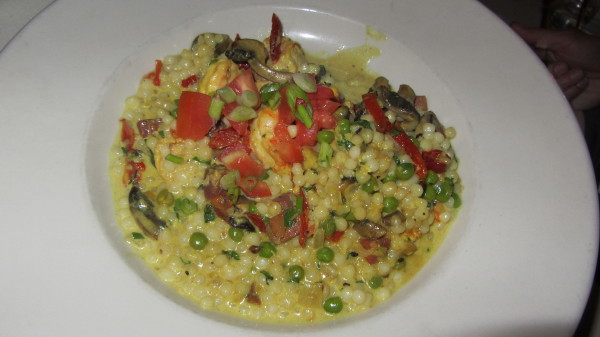
Shrimp and couscous (Chuck and Gretchen)


Pete, Chuck, Gretchen, Claire


Second Day

Today we met with our guide, Clara, and a small group of 7 for a Charleston Stroll, a historical and architectural walking tour of the old town.  They take their preservation seriously, here--any building more than 75 years old must get permission before making exterior changes.  Tourists benefit. 

Charleston has a long and interesting history.  Founded in 1670, it was involved in both the Revolutionary and Civil Wars.  It has a tradition of living in style and a social consciousness that goes with it.  We are told that you aren't a native until your family has been here for 3 generations.  I was surprised to find out that Carolina (Carolina is Latin for "Charles land") was not originally a colony--it was a Lord's Proprietorship granted to 8 nobles by King Charles II for the loyalty of those worthies in restoring the Crown to England after Cromwell's reign.  Carolina was settled to make profit from trade and also by selling land.  John Locke, an English philosopher, wrote a constitution for the colony that covered topics such as land divisions and social rankings.  The town of Charleston was originally named 'Charles Town' for the King; it was renamed in 1783. 

One of the stops on our walking tour was this striking columned building.  Charleston was a polyglot community and each of the ethnic groups had its own society, which has limited membership.  This was the meeting house for the Irish.  The pillar between the endmost right columns are stones from The Giant's Causeway in Northern Ireland.  Speaking of stones, there are virtually none in this area; the buildings are either wood or brick--though sometimes the brick is covered with stucco, and a few houses have faux stone lines carved into them.  We thought it delightful that they alternated between Catholic and Protestant presidents of the organization.  There is a limited membership, so parents sign up their children for eligibility at birth. 


  $5 million house for sale.  Real estate near the tip of the peninsula is a tad pricey. 

 Office out back--guess they didn't have enough room in this block-long mansion

19th Century thief deterrent.  This house was once owned by a slaver and blockade runner named  Rhett.  Some people believe he provided the model for the Rhett Butler character in Gone With The Wind.


Classic "single" house with side piazzas (their word) to benefit from sea breezes.  Double (Side by side) houses would not permit air to flow through from one side to the other.  A $1,000 a plate fundraiser with Obama in attendance was held here in 2008.  This year it was $30,000 a plate.  He mistakenly called the piazzzas porches.  These were often used in warm weather, with windows open on both sides, to allow air flow to cool off the occupants.  They sometimes sleep on their piazzas in the summer.


This house with cupola helped cool the home down when opened along with front door.  The wind passed through as with a house fan. 


Waterfront and homes

Locals call this the "Chinese, Chippendale, Victorian" house

Dixie Supply, a lunch spot, earned best dining experience in Diner, Drive-in and Dive category

 Their specialty:  Tomato pie, with molasses cake for dessert, delicious!

Next stop, Lowcountry Bistro for dessert, again

Their specialty:  Grilled cornbread strawberry shortcake.  Need I say more? 

 The Battery

The Arthur Ravenel Bridge opened during a week-long celebration in July 2005. It is an eight-lane, cable-stayed bridge with two diamond shaped towers that allow clearance for modern ocean freighters to access the Port of Charleston.  It hosts an annual Cooper River Bridge Run and has a bicycle and pedestrian lane. 


Rainbow Row.  This is an iconic image of the city and is found on postcards, ash trays, refrigerator magnets--almost anything that can hold a picture.   The drivers of the horses and carriages face backwards while addressing their gaggle of tourists.  I saw one driver repeatedly look over his shoulder as he approached a traffic light--to be sure his horsed didn't either run the light or ram a car.  I don't think pedestrians are a major concern, here.  We are careful when we cross the street.


Shutters that open up and down.  A great convenience, as ordinary shutters often require that you go outside to release and close them.


A blend of styles?

Dentist's home, painted the color of healthy gums. His enterprising young daughter used to sell pink lemonade to tourists.  She made a small fortune, as there are no commercial interests south of Broad Street--and this is some distance away.


Iron work balconies.  This is one of the touches that reminded us of New Orleans here.

More piazzas

Halloween is just around the corner

St. Michael's Episcopal Church, designed to look like St. Martin-in-the-Field in London, where we dined in the crypt several years ago.  This is famous, partly because George Washington prayed here during a week long stay.  He is rumored to have said this "lengthy" sojourn here was because Charleston had such pretty ladies.  Robert E. Lee also attended this church.


 Circular Congregational Church

We visited City Hall to see a famous painting.  Charleston is rightly proud to possess a John Trumbull portrait of George Washington, painted during the president’s lifetime.  Commissioned by Charleston, the painting portrays Washington after his 1791 visit to that city. 

Trumbull’s first effort, which shows Washington after his 1776 victory at Trenton, New Jersey, did not please the city fathers, for Trumbull had portrayed the Battle of Trenton, not the city of Charleston.  They turned it down, and Trumbull produced a second work.  This one showed an identical Washington posed on the shore of Charleston Bay, with the city skyline in the background.


Charleston’s leaders were pleased this time, paid Trumbull his commission, and he promised to deliver the painting after he had added some minor details.  The rejected Trenton portrait was kept by Trumbull, who eventually gave it to the Society of Cincinnati.  When the society was dissolved, they presented it to Yale University.  Trumbull's crypt is nearby.

Trumbull’s “minor detail” was Washington’s mount.  The artist turned the animal around.  Now its hindquarters are prominently displayed, with its tail raised as if the horse is about to relieve itself upon a boat containing the city fathers (which isn’t visible in the photograph).  Charleston’s skyline appears in a most-vulnerable position – between the horse’s thighs.  The painting is aptly nicknamed Trumbull's Revenge.

We liked our luncheon dessert so much that we returned to Lowcountry Bistro for dinner.  It was wonderful.

Sangria--ciroc peach, pineapple, sparking wine, pure cane syrup, muddled fruit

Shrimp and Grits--grilled shrimp, parmesan & chive grits, fried green tomatoes, smoked tomato & bacon sauce--fantastic!

According to our guide, Condé Nast Traveler readers recently voted Charleston, South Carolina, the number one city in the United States for the second year in a row.  This year the magazine announced its readers have now voted Charleston the top tourist destination in the world.  The designation is based on a poll of about 47,000 readers of the magazine who judge cities on a five-point scale.  The categories include ambiance, friendliness, lodging, restaurants, culture/sites, and shopping.  


I'm going back to dignity and grace. I'm going back to Charleston, where I belong. ~ character Rhett Butler, in 1939 movie, "Gone with the Wind"