Monday, October 1, 2012

Frank Lloyd Wright, Again

By Claire

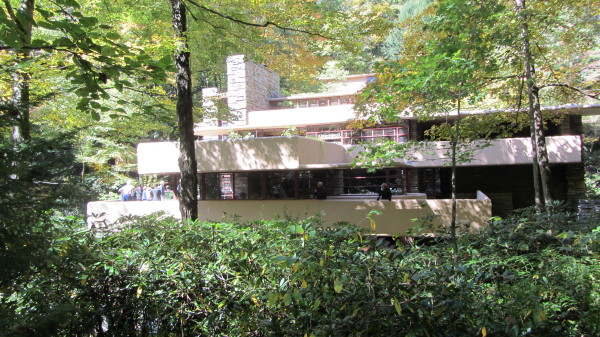
You didn't think we were through with Frank Lloyd Wright did you?  Not by a long shot!  Today we visited Fallingwater, one of his most extraordinary creations.  He designed it in 1935 in rural southwestern Pennsylvania.  The home was built partly over a waterfall on Bear Run in the Laurel Highlands of the Allegheny Mountains.  What a gorgeous location!

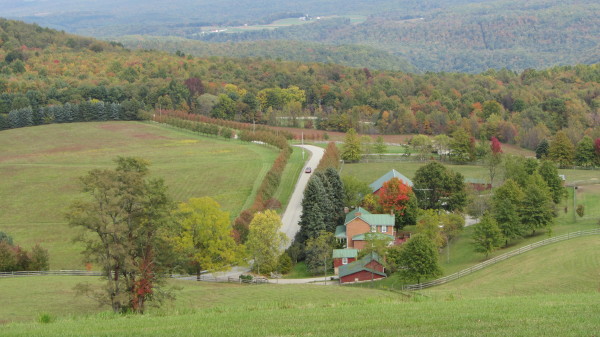
Driving into Fallingwater

It was hailed by Time Magazine, shortly after its completion, as Wright's "most beautiful job," and is listed among Smithsonian's Life List of 28 places "to visit before you die."  So we did--visit.  

First view

We walked down a long path to reach the house, hidden among the trees.  The house was owned by Edgar Kaufmann, a successful Pittsburgh businessman and president of Kaufmann's Department Store.  Clearly, he had money.  He and his wife owned the property, all 1600 acres, and used it as a retreat for themselves and their employees.  They loved the area and came often from their home in Pittsburgh, about 70 miles away.   Their son, Edgar Kaufmann, Jr., studied architecture briefly under Wright at Taliesin.  Wright visited Bear Run and later, while enjoying refreshments with the Kaufmanns at their home in Pittsburgh, he said to Edgar Jr.--in tones that the elder Kaufmanns were intended to overhear, "Edgar, this house is not worthy of your parents..."  The remark spurred the Kaufmanns' interest in something worthier.  Fallingwater is the result.


We were so lucky to be able to take a tour of this amazing place.  It is quite large at 5,300 square feet, which includes the terraces--FLW considers the outside part of the inside in his designs.  Views from every window brought nature into the rooms.  Each of the parents and their son had their own private retreat area.


This shows the supports used  for one of terraces. They are sitting on a boulder.  Another boulder is under the kitchen and extends into the living room where FLW built a fireplace around it.  It was the boulder Mr. Kaufmann used to sunbathe, and he was delighted to have it in his living room.


Because of its placement over a natural creek, there were windows over a set of outside stairs.  Opening these windows brought in natural air conditioning.  There was also a plunge pool at the bottom of another set of stairs. Up at the guest house was a swimming pool.  Wright did not believe in swimming pools, preferring natural watering holes.  The Kaufmanns built a pool 6 feet deep that had fresh water running in while draining out the other end at the same time.  This was done after Wright was finished. 


 There are beautiful paths all around the property.
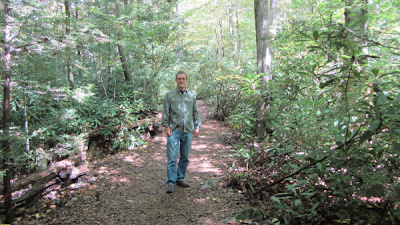

 Visitor Center, beautifully nestled into the forest

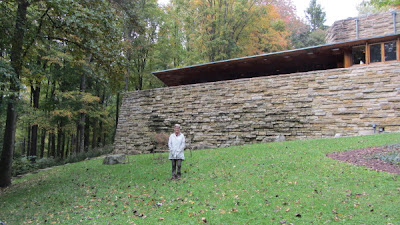
Chuck found out about another FLW property, nearby, and made arrangements to tour that as well.  This one is called Kentuck Knob. Commissioned by the Hagan family after visiting nearby Fallingwater, this house showcases FLW's architectural genius and innovation.  He used the surrounding landscape to masterful effect as the framework for this custom Usonian home.  The house is surrounded by spectacular mountain vistas.  Usonia is a word used by Wright to refer to his vision for the landscape of the United States, including the planning of cities and the architecure of buildings.  He used 'Usonian' in place of 'American' to describe the particular New World character of the U.S. Landscape, as distinct and free of previous architectural conventions.

Our tour was thorough and informative, but as usual, no photos inside.  Frustrating!  You will just have to come to these sites yourself.  We did learn that he used hexagons, triangles and 30, 60 and 120° angles in the design.  There are only two right angles in the house--one in the bathtub and one in a closet.  He was forced to do this because the plumbers said they could not fit the bathrooms otherwise.  He never saw the property but used topographical maps and photographs to design it.  He only visited once, during the construction phase.  Mrs. Hagan badly wanted an attic for her Christmas ornaments but Wright did not believe in attics or basements, believing they brought clutter and disease.  She called him repeatedly, trying to get him to visit the completed house, but he refused--due to his extremely busy schedule (he was 86!).  She was certain he would never come, so she had an attic space built above her bedroom with a small door installed for access. 


Entry light

He also believed in carports rather than garages, which can hide accumulated junk.


Closer view of the detail.  The carved design is actually windows.  Wright designed all the furniture, as usual.  He had begun designing mostly built-in furniture, which he dubbed "client safe" because of their habit of rearranging things in ways he never intended.


The backyard stretches for 80 acres and includes a sculpture garden which includes works by Andy Goldsworthy, whose film, Rivers and Tides is a must see.


Nice bench for sitting and breathing in the forest air.  Mr. and Mrs. Hagan planted 8,800 seedlings  themselves.  She was somewhat disappointed years later, though, when she lost the view of the hills and mountains from her living room.


These are hexagonal skylights that work as a sundial and calendar.  They are on a southerly exposure and the time of day is indicated by the angle of the sun casting shadows across the porch--light moves up the porch during the day.  The time of year is shown by the relative position of the sun in relation to the house--in and out shadows are cast depending upon the season.  There is no glass in the skylights: The contractor convinced FLW that the strong winds would blow off the eaves and the copper roof.  Chastised, Wright is alleged to have told his architectural students that the world's most brilliant architect was humbled by a mere upland Pennsylvania builder.


Mrs. Hagan still had the view screened by her trees, she just had to walk a few yards to get there.


Back of the house  

In the back yard
  

This view is supposed to represent the prow of a ship.  Remember the Unity Church in Madison? Same idea is presented here--building and nature integrated.  Wright doesn't build on a hill, he builds into a hill.

Driving to our lodging for the night, Chuck spotted this nice spot. Its in the town of Ohiopyle--we wish we knew how to pronounce it.  Chuck thinks maybe a Greek version is intended.  Who wants to live in a town that is a pile...of what? Furthermore, why are we talking about Ohio while we're in Pennsylvania?


 One of the many beautiful change of seasons displays we have seen.


Early in life I had to choose between honest arrogance and hypocritical humility. I chose the former and have seen no reason to change. ~ Frank Lloyd Wright


Sunday, September 30, 2012

Rock & Roll Is Here To Stay

By Chuck & Claire

Driving from Chicago to Cleveland, we drove through Ann Arbor. I (Chuck) had always wanted to see the campus of the University of Michigan.Two reasons: First, my stepfather was a lithographer and the company he worked for did the football programs for Stanford University. The Wolverines were one of the annual opponents of the Indians--now The Cardinal. Second, As an undergraduate in college, I had a Philosophy professor from India who got his Ph.D. from UM; but, he always referred to it as "that hell hole," presumably, that was due to the weather. I was curious and this is what we say--more than pleasant during our very brief tour of the campus.

It is a giant campus, spread over many, many blocks--if not miles--by the time you account for the athletic facilities.  It has a student body exceeding 42,000 and is regarded as one of the top 20 universities in the world.

We had a Ben & Jerry's, to celebrate finding a nearby parking spot and then walked about the campus.  The buildings are impressive, but not themed on a particular style.  I was surprised to note that they have several museums scattered about the core campus.  But, we had miles to go before we slept, and moved right along to Cleveland.


I have to say that seeing the Rock & Roll Hall of Fame was possibly the best museum experience of my life.  We opened the doors in the morning and stayed until the closing announcement. We vowed not to waste time eating until we left.  We had only one day to experience this and discussed how to approach it over the last few days.  We determined that we should separate, joining for the U2 3D movie and then parting until the end. It worked well; but, we did encounter each other a couple of time--the place was not that big, nor was it, thankfully, crowded.

I quickly determined that I did not care about the "stuff" in the exhibit halls.  I wanted to see the videos and hear the music.  I have always loved music, but in an informal, "I know what I like when I hear it" sort of way.  I could never tell you what year a piece was from, almost never knew the lyrics, and rarely knew the names or faces of people in a musical group.  So, today was a genuine educational experience.  In particular, I learned much about who migrated among which groups.  I also was reminded of many names I had forgotten over the years--Bo Diddley, LaVerne Baker, Little Willie John, and more.

But mostly, I enjoyed the feeling of remembering people, lyrics and tunes, the desire to tap my foot, to dance again. I loved feeling an almost constant smile on my face as I recalled melodies and performers--and even people from my past that I associate with these.  I enjoyed the feeling of unity engendered by much of the music and many of the performers--and this extends far beyond the Peace and Love days of the late 60's.  I almost cried for some of the music--not sure of the reason.  Could have been the content of love, the sweetness of youth, the loss of innocence, the reminder of my mortality--or all of the above.  Doesn't matter.  In short, I heartily recommend this lovely bit of nostalgia. 

The one complaint was over the way some of the juke boxes were set up.  One kind would quit playing music when you returned to the top level of the selection tree.  Another kind forced you to select music by decade and then, several layers down, only allowed you to play numbers with a speaker icon next to them. There were precious few of these.  I finally quit in frustration--and in the growing realization that I was running out of time.

View from our hotel window. That is the R&R Hall of Fame on the left and Lake Erie in the background. 


Sculpture in the Park around the corner from the hotel, on the way to the Hall.


View up 9th Street in downtown Cleveland as we look back during our walk to the R&R Hall of Fame.


The Cleveland Browns football stadium.


Proof of payment and heirloom to be passed on to my children, thence to their children, continuing 'til the ending of the world.


Designed by I.M. Pei, the Rock and Roll Hall of Fame is on the shores of Lake Erie and is only a holler away from the Cleveland Browns' football stadium.  "It is a composition of bold geometric forms and dynamic cantilevered spaces that are anchored by a 162-foot tower.  The tower supports a dual-triangular-shaped glass “tent" that extends (at its base) onto a 65,000 square-foot plaza, providing a dramatic main entry facade...The building houses more than 55,000 square-feet of exhibition space."


The front of the R&R Hall of Fame building has a sculpture garden of guitars. 


This is Johnny Cash's touring bus. In 1991, he traveled on it with Kris Kristofferson, Willie Nelson and Waylon Jennings during the Highwayman Tour.


By Claire

We didn't eat, barely took bathroom breaks, and researched in advance; in short, we wanted to fit as much as we could into the 7-1/2 hours available to us.  We had originally planned on 2 days; but I woke up with a red, swollen and painful eyelid on Thursday (4 days ago).  I kept an eye on it (no pun intended) and finally decided on Saturday (of all days!) to see a doctor.  This meant finding an urgent care or emergency room.  Our hotel directed us to St. Vincent Charity Hospital, a mile away.  We found it easily, and there were only 2 people ahead of me.  But, it still took a total of 3-1/2 hours to get it all done, including picking up an antibiotic prescription.  By the time we made it back to the hotel, it was after 3 pm.  I was really bummed, but that's the way it is sometimes. I have an infection and it will eventually clear up.  I'm glad I had it checked out.  The good news is, the hospital billed Kaiser!

It started out gray and chilly as we walked the few blocks to the magnificent Rock & Roll Hall of Fame and Museum.  Can I just mention that my face hurt by the end of the day from smiling so much?  The big exhibit at the moment is the Grateful Dead, The Long Strange Trip.


Photography is not allowed inside but I decided to risk it for this shot through the fantastic glass pyramid by I.M. Pei.  Earlier it had poured rain--what a great place to be on a day like that!  Later though, the sun was shining brightly so I couldn't resist the photo.


We started with Mystery Train, a 12 minute introductory film about the beginnings of Rock & Roll.  It was completely engaging and we were already moving to the music and getting in the mood.  From there we split up--it's really a solo experience, but great fun to share and talk afterwards.  I wandered towards the Elvis exhibit, checked out the usual outfits with capes and made my way over to a huge video screen where I sat down to watch.  Before I knew it I was seized with emotion--almost hysterical laughter and welling tears.  There is just something about Elvis.  They melded together clip after clip of Elvis movies, he with the technicolor orange pancake makeup and jet black hair, kissing girl after girl in hilarious scenes with either fireworks going off, wagons collapsing or something blowing up.  This morphed into various videos of his later "come back" shows where his face was beginning to look puffy.  But, he was amazing and I was riveted.  After awhile I decided I had seen so much of Elvis over the years, including a memorable trip to Graceland 20 years ago, that I needed to keep to my schedule.

I quickly strolled through a photography exhibit, noting Sting with The Police, looking very young.  From there I ventured into Legends of Rock and Roll featuring the Beatles, the Rolling Stones, Jimi Hendrix, the Doors, U2, David Bowie, Michael Jackson, the Who, the Supremes and others. I was touched by the art work of Jimi Hendrix from when he was in elementary school; what talent!  Loved some of David Bowie's outfits and his hairdos!  Did you know that he doesn't really have two different colored eyes?  One eye is slightly dilated which makes it look that way.  The Supremes' dresses were tiny!  I cracked up at Michael Jackson's glove, displayed in a glass jar, just like Gallileo's finger. Suddenly I ran into Chuck and we realized it was almost time for our ticketed U2 in 3D experience in a theatre on the 4th level.  Yes, there are many levels--7 to be exact.

The 85 minute U2 film was fantastic and the 3D really worked.  There were moments when I really thought I was at a concert and wanted to tell the people in front to sit down.  Then I realized it was all on screen.  What a blast! 

We split up again and I went to the American Bandstand film in another small theatre.  Talk about nostalgia!  I almost never missed that show at 4 pm every weekday after school.  Dick Clark just never seemed to age, only his hairstyle changed with the times.  Could John Travolta really have been that young?  And skinny?  How about the Bee Gees?  So much hair! 

Next I made my way up to Level 3 and the Induction Ceremony Highlights, shown on 3 television screens.  Those were fun.  I loved it when Mick Jagger, dressed in a tux, commented that they were all there on their best behavior to reward their bad behavior.  Walking into another theatre, they were showing clips of each artist or group that had been inducted, year by year.  Remember Brenda Lee?  How about Jackie Wilson doing the splits then coming up slowly and kind of dancing around from his knees, still singing, then leaping up from this position and jumping into a dance routine?  This was shown on three large screens in a medium sized theater and went from 1986 to 2012.  Again, I was rocking out with the music.

While all this was going on, I did manage to notice other people, but only in a peripheral way.  It just wasn't that crowded and I felt like I was part of a community.  The age range was interesting.  Families with kids, parents proudly educating their children about their heroes, couples in their twenties and every other combination.  I even sat behind a threesome of elderly ladies with white hair, one wearing a Chanel style jacket.  I didn't take the time to see if she was wearing pearls.

Walking out of the Inductees Film, I decided to look at all their the signatures.  Found my favorite.


LL - Lower Level really has the largest number of exhibits in one area, so I headed back that way.  By now I was getting hungry so I stealthily ate a granola bar in the shadows with my eye out for a guard (no food or drinks are allowed) while I checked out Janis Joplin's Porsche.  So cool, and to think she just drove it around and parked it on the street.  People got to know it and would leave notes for her under the wiper.  As you can see, I was becoming less and less worried about being caught with my camera.  I was discreet.


Another touching exhibit to me was the Everly Brothers.  I just loved their little custom made tap shoes that their mother bought them with shoe ration cards during WWII.  They were so little.

This was one of the best days of all.  It may be at the top of my list by the time this trip is over.  I thought it would be Taliesin or Yellowstone, but I was so thoroughly involved in this museum.  I don't think I have ever spent this much time in a museum wishing for more.


One good thing about music. When it hits you, you feel no pain.  ~ Bob Marley

Thursday, September 27, 2012

Last Day in Chicago

 
By Chuck

Today was our last day in Chicago. We decided to play it light and easy--one real destination and then home again. At the last minute this morning, Claire decided we could try the hotel restaurant: This saved us time and money--we could eat before we caught the Double Decker bus to the Field Museum of Natural History, rather than try Wildberry Pancakes and Café in the middle of our route. Turns out that trying to keep fruit and yogurt fresh by means of the hotel ice machine and an ice bucket just doesn't work out too well.

Aaron, our Chicago guide, providing us with a free harmonica blues concert. We found out a good Blues joint is only 2 blocks away from our Best Western Hotel; but, by evening we are generally more than ready to call it quits.


 Another beautiful Chicago building.


The Flamingo by Alexander Calder

The only scene from the movie musical, Chicago, that was filmed here.


Finally, the actual Marshal Field building, known for the clocks on its corners.


We hated to admit it, but we liked the Trump Tower.


This is the Jeweler's Building. It had elevators that would allow the armored cars carrying their diamonds to deliver them to their floor, a security precaution. Hah! Apparently, no one told them that Al Capone controlled the fancy speakeasy at the top during the Prohibition years.

By this time, we had developed very sore necks over the past several days from all the craning to see the tops of skyscrapers. Thank goodness, we are done for a while.


Soldiers Field has had two lives. Once it was a Classical stadium with Roman columns and housed 100,000 fans; it was thought to be too large for the Chicago Bears and was redesigned and modernized and now holds about 65,000.


This is the outside of the Field Museum. It is about a city block in size and houses wonderful collections on almost everything.  We got the comprehensive ticket for Seniors that allowed us to see the general collection, a movie and two special exhibitions.


The first exhibit we saw was Sue, the largest and most complete Tyrannasaurus Rex ever found. She is 40.5' long, has a skeletal weight of 3,922 pounds and is quite impressive. Her head is so heavy that they have to use a lighter substitute in the display, to support the weight.  We opted to see the 3D movie about her and thought it was very well done, combining CGI and documentary styles.

The special exhibit, Extreme Mammals, was quite interesting.  It showed a variety of animals, living and extinct that were unusual: the biggest, smallest, and most amazing mammals of all time.  We were able to inspect oversized claws, massive fangs, extraordinary snouts, amazing horns, and other traits that make these mammals truly remarkable.


This was an interesting graphic display comparing the size of Africa to that of several major countries.  So, it is larger than the U.S., India, Argentina, Europe and China combined!


3D Movie fan preparing for battle

The Field Museum from the Upper Floor, looking back toward our entrance.  We were quite pleased with the openness of the entire museum. It was also, happily, lacking in crowds--In fact, when we arrived at 10:30am, we thought we had come on a day when it was closed! Fortunately, we were mistaken.


Aerial View of the Principality of Monaco from the series Lilypad, A Floating Ecopolis for Climate Refugees. This floating amphibian city, half aquatic and half terrestrial, is a solution for refugees displaced by the rising waters created by climate change.


We loved our day here and spent 5 hours!  What a treat to live in this city and have constant access to the Art Institute and the Field Museum.
 
Observations and Recollections

The name "Chicago" is derived from a French rendering of the Native American word shikaakwa, translated as "wild onion" or "wild garlic"; in other words, it was a smelly swamp where people hunted, but no one wanted to live.  Everything west of Michigan Street is on land fill made possible by the horrific Chicago Fire of 1871;  Chicago Tribune reporter Michael Ahern published the story that the fire started when a cow kicked over a lantern while a woman was milking it. Though the woman was not named in the original report, Mrs. O'Leary was soon identified, since her barn had been the source. Various illustrations and caricatures soon circulated, depicting Mrs. O'Leary with the cow. The story took the population's imagination and is still widely circulated.  Ahern admitted in 1893 that he had made the story up because he thought it would make colorful copy.  Anti-Irish attitudes at the time encouraged stories scapegoating the O'Leary family. It was claimed that the supposed accident happened because she was drunk, or that she hid the evidence to avoid being blamed. Neighbours later claimed to have seen shards from the broken lamp, but none of these stories could be verified.  She was ostrasized, her life ruined, and it is said she died of a broken heart.

As Chicago grew, in the 1800's, it became necessary to plan for sewage disposal. After the first attempt, raising much of central Chicago to a new grade, the untreated sewage and industrial waste now flowed into the Chicago River, then into Lake Michigan, polluting the primary source of fresh water for the city. The city then responded by tunneling two miles (3 km) out into Lake Michigan to newly built water cribs. Finally, in 1900, the problem of sewage contamination was largely resolved when the city reversed the flow of the Chicago River so that it flowed away from Lake Michigan, rather than into it. This project began with the construction and improvement of the Illinois and Michigan Canal, and was completed with the Chicago Sanitary and Ship Canal that connects to the Illinois River, which flows into the Mississippi River. So, the Chicago sewage problem has apparently been shipped down the river to another community.

Although weather is severe here, the appellation, "Windy City" is apparently not from the weather. Rather, New Yorkers applied it to the words of politicians and other worthies who extolled the virtues of Chicago while competing for the right to host the World's Columbian Exposition of 1893-4.  Speaking of weather, we have been delighted by our good fortune in having marvelous weather our entire stay.

Millennium Park was privately financed and expected to cost $150 million in 2000. It was finally finished in 2004 at a cost of $450 million. But, it is a great park.
The famous "Corn Cob" buildings (aka Marina City) were the site of a scene in Steve McQueen's movie, The Hunter, where during a car chase in the garage of the building, his character pushes a bad guy's car over the railing and into the Chicago River. There have been reports that people once had a Frisbee tossing competition between the two buildings.

The historical Route 66 began at the Chicago Art Institute. Virtually all railroads once ran through Chicago. According to our guide, "You have a better chance of getting away with murder in Chicago than with being governor and not being convicted of corruption.  "Six Illinois governors have been charged with crimes during or after their governorships; four were convicted."

The Marx brothers grew up on the South Side of Chicago and lived there until they moved out onto a farm to avoid the draft in World War I.

We have been repeatedly impressed by the friendliness of people in Chicago: People would stop and ask if we needed directions, if we stared at our map too long. Cars--other than taxi cabs--rarely honked. Hotel personnel would smile and ask, sincerely, if they could help. Our hotel was $167 a night, including the only free downtown hotel parking in Chicago--we felt smug when our guide mentioned a "bargain" hotel for $250 a night with tiny rooms and horrible beds.  Our room is quite large, and we love the location--we can walk (and walk) to any central location.

Total tab for five days and nights in Chicago: $1324. This is just under $266 per day. I shudder to think what it must run folks who travel less austerely than we do.

We are torn between nostalgia for the familiar and an urge for the foreign and strange. As often as not, we are homesick most for the places we have never known.  ~ Carson McCullers