By Claire
The forecast was for rain, and we needed and wanted to see two museums--the Guggenheim and the Metropolitan Museum of Art. Our plan was to get to the Guggenheim when it opened at 10, take the tour at 11, lunch, then walk to the Met and do the Highlights Tour at 1:45. We didn't realize that the newest exhibit at the Guggenheim, Picasso Black and White, had just opened on Friday. Add the rain and a Sunday--well, you get lots of people.
The line was down the block at 9:45 when we arrived, but we made our way in with only minor pushing and shoving. We purchased our tickets and walked through a low ceiling, narrow entry which opened up into the large first level where we took in the breathtaking rotunda. It is another example of Frank Lloyd Wright's genius. He tricks you with compact space then awes you with size. We walked up and around the circular ramp, marveling at how perfectly everything worked as a space. It was intimate, yet uncrowded. You can see art from across one side of the ramp to another. Below is a photo I took off the internet to give you a really great example of how amazing this building was and is, set in the New York cityscape. And it opened in 1959! It looks so modern. FLW hated New York--don't forget he was a nature boy--but agreed to design this building only because it faces Central Park. With the use of a large window on the bottom level, he was once again able to bring in the green of nature and the natural light. He added a skylight at the top to flood the entire circular structure with additional light. FLW did not live to see the finished product but was inside the construction phase close to the end.


With his model of the Guggenheim

That's Chuck in the blue rain jacket

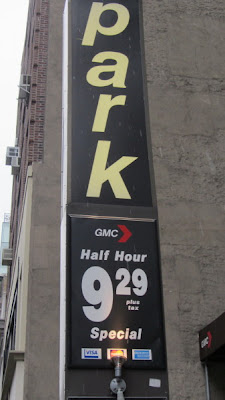
 On my journey home on foot and by subway, I came across this sign. It pretty much says it all.


The forecast was for rain, and we needed and wanted to see two museums--the Guggenheim and the Metropolitan Museum of Art. Our plan was to get to the Guggenheim when it opened at 10, take the tour at 11, lunch, then walk to the Met and do the Highlights Tour at 1:45. We didn't realize that the newest exhibit at the Guggenheim, Picasso Black and White, had just opened on Friday. Add the rain and a Sunday--well, you get lots of people.
The line was down the block at 9:45 when we arrived, but we made our way in with only minor pushing and shoving. We purchased our tickets and walked through a low ceiling, narrow entry which opened up into the large first level where we took in the breathtaking rotunda. It is another example of Frank Lloyd Wright's genius. He tricks you with compact space then awes you with size. We walked up and around the circular ramp, marveling at how perfectly everything worked as a space. It was intimate, yet uncrowded. You can see art from across one side of the ramp to another. Below is a photo I took off the internet to give you a really great example of how amazing this building was and is, set in the New York cityscape. And it opened in 1959! It looks so modern. FLW hated New York--don't forget he was a nature boy--but agreed to design this building only because it faces Central Park. With the use of a large window on the bottom level, he was once again able to bring in the green of nature and the natural light. He added a skylight at the top to flood the entire circular structure with additional light. FLW did not live to see the finished product but was inside the construction phase close to the end.


I thoroughly enjoyed out tour with Wendy, an artist herself. There were 3 of us at the start and two more jumped in as we were talking in front of one of Picasso's paintings. I have never really been a fan, but Wendy took us to about 5 paintings and a sculpture from different periods, explaining in detail what we were seeing. She also asked for feedback from us and it was interesting to hear what the others thought. Each example she used of his work was unique. I have a new appreciation of Picasso.
We grabbed a very nice lunch in the café, which was crowded by now--at noon--with few tables. I was lucky to get us two seats. Next up, "A Long Awaited Tribute: Frank Lloyd Wright's Usonian House and Pavilion." On October 22, 1953, Sixty Years of Living Architecture opened on the site where the Guggenheim Museum would eventually be built. Two Wright-designed buildings were constructed specifically to house the exhibition: a temporary pavilion made of glass, fiberboard, and pipe columns, and a 1,700 square-foot, fully furnished, two-bedroom model Usonian house representing the architect's organic solution for modest, middle-class dwellings (Forget about Kentuck Knob--that "modest" Usonian dwelling ended up costing $96,000 back in 1955). Despite his fifty years of international architectural recognition and practice by 1953, Wright had yet to erect a building in Manhattan. How did we get so lucky to see, yet again, another Frank Lloyd Wright building and an exhibit?
With his model of the Guggenheim

We hustled off in the rain, 4 blocks south to the Metropolitan. As we approached I could see the masses crowding around the front doors, queuing up to get in. I am not a crowd person. However, I was determined to see this iconic building and a tiny bit of its contents. Trying to avoid eye damage from pointy umbrellas, we pushed through the crowd along with everyone else. After a bag check for our two purses (Chuck does carry a man-purse for our maps and guide book), we were swept into the incredibly long lines where, in the distance, you could faintly make out what the prices were ($25 adults, $17 seniors). It wasn't the long line so much as it was the continual body contact with strangers and the people screaming into their cell phones--do they really think the party to whom they are speaking cannot hear them??? At any rate, I bailed. I just knew I would not be having a good time. Chuck will tell me all about it when he returns. In the meantime, I am going to finish reading the Sunday New York Times.


By Chuck
I came to the Metropolitan Museum of Art once before--in 1965. I saw a painting that made a very strong impression on me. There were surgeons who had just finished operating, had blood on their hands, and the doctor in the foreground was wiping his bloody scalpel across his vest. I was unable to locate it, today, despite several turns through the American Art section of the museum and asking several docents, guards and information desks. Disappointing.
The Highlights Tour was excellent. Each docent gets to make up his or her own tour. Beverly, our guide, asked a friend what she would like to see in such a tour. Answer: Something jaw-dropping. She succeeded in doing that. We saw examples of sculpture by American, African and Roman artists. I thought the work Ugolino and His Sons, by Jean-Baptiste Carpeaux (1827-1875), was amazing. The original composition was cast in bronze (1862-63; Museé d' Orsay, Paris).
It tells the story of the Pisan traitor, Ugolino della Gherardesca, imprisoned with his sons and condemned to starvation, and was told by Dante in The Inferno (canto 23). Carpeaux shows the anguished father resisting his sons' offer of their own bodies for his sustenance. The detail is unbelievable: You can even see the tensing of muscles and the indentation of the fingers on the father's leg! This version was executed in marble in France (Paris), 1865-67.

Also memorable were the painting of George whats-his-name crossing the Delaware River--for the realistic detail and the symbolism in this oversized image--and the picture Heart of the Andes by Frederic Edwin Church--this latter was the only image from the Met in our Frommer's NYC Guide Book. It was inspired--some 50 years later--by images from Alexander von Humboldt's expedition to South America (1799-1802). These were both part of a successful pay-per-view showing back in the 1850's.
I finished off by seeing the Frank Lloyd Wright living room from Little House, originally built in 1912-14 in Minnesota. This is all that is left of the house, today. It looked beautiful and familiar.

The world today doesn't make sense, so why should I paint
pictures that do? . . .I paint objects as I think them, not as I see
them. ~ Pablo Picasso


