By Chuck
Today was my first trip to Philadelphia to see the historical sites. I lived on the East Coast for years while in graduate school, and, so, found it hard to find time to be distracted by "mere" history and sightseeing. My only ventures into those areas were prompted by visits from friends and relatives. This is the trip to begin to compensate for those failings.
Regarding myself as a pacifist during my years living in Maryland--coinciding with the period of the Vietnam War--I studiously avoided visiting the Civil War battlefield sites. I recall seeing Pearl Baily's version of Hello Dolly at Ford's Theater when, during intermission, President Lyndon Johnson--a great fan of hers--came out onto the stage. He received a standing ovation from the crowd, but I felt I was making a profound statement in opposition to the war by remaining silently seated. Oh, the conceits of youth.
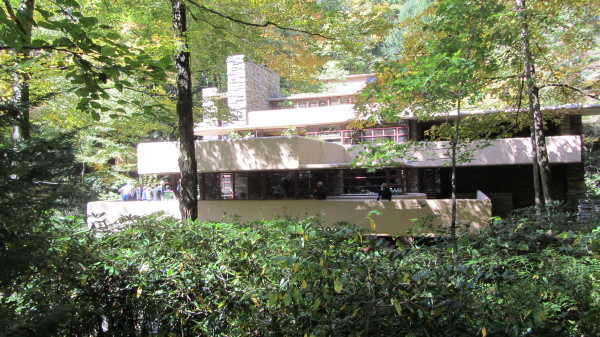
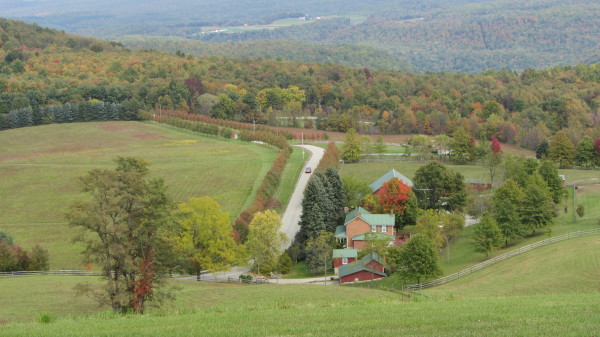
Yesterday, Leaving Fallingwater, I was determined to finally visit Gettysburg. Traveling through miles of blinding rain and intermittent heavy fog, we finally arrived at the site. The visitors hut was closed, though it was possible to obtain brochures detailing how to take a 24 mile self-guided driving tour. I quickly decided that the weather conditions made that trip virtually pointless; so, I contented myself with a quick reading of the brochure and a promise to follow up with reading at a later time.
Our first view of the battlefield area.

The Battle of Gettysburg, Pennsylvania (July 1–July 3, 1863), was the largest battle of the American Civil War as well as the largest battle ever fought in North America, involving around 85,000 men in the Union’s Army of the Potomac under Major General George Gordon Meade and approximately 75,000 in the Confederacy’s Army of Northern Virginia, commanded by General Robert Edward Lee. Casualties at Gettysburg totaled 23,049 for the Union (3,155 dead, 14,529 wounded, 5,365 missing). Confederate casualties were 28,063 (3,903 dead, 18,735 injured, and 5,425 missing), more than a third of Lee’s army.

These largely irreplaceable losses to the South’s largest army, combined with the Confederate surrender of Vicksburg, Mississippi, on July 4, marked what is widely regarded as a turning point—perhaps the turning point—in the Civil War. Nuff said.
Finally arriving in Philly, we had to stop to have Cristina serviced, as she was not allowing us to read her entire ECO display--real time reporting of mileage, mpg and average speed--until we had our 9,000 mile service. We are so used to viewing this as we drive along that we decided to stop now rather than try to squeeze it in at some unknown future date. Unfortunately, this cost us 2.5 hours waiting in a dingy Toyota waiting room; but, they were extremely friendly, and they did manage to fit us in with minimal notice.
View of Ben Franklin Bridge from our 10th floor room

We had dinner at the Race Street Cafe, which was recommended somewhere online. Claire finally found the food she has been missing: "Deconstructed Quinoa Napolean," which consists of crispy quinoa cake, portobello mushrooms, roasted peppers, sautéed spinach, fresh mozzarella and a tomato ragout with white bean mash. Fabulous! Supplemented by a draft Dock Street spicy copper Pumpkin Ale.

I settled on ordinary, Old World stuff: Shepherd's Pie. Loved it. The draft chaser was a Green Flash double stout with hints of coffee, chocolate and anise. This baby was 8.8% alcohol.

We saw this mural on a brick wall as we walked toward the various Independence sites this morning.

Betsy Ross's residence and place of business.


Lovely courtyard area on the way downtown

Building associated with the home and offices of Benjamin Franklin. They are currently building a new BF Museum in the rear.

The Liberty Bell was cast and tested. It cracked. It was melted and recast. Again, it cracked. The third version lasted awhile and then cracked. It resided at various locations inside Independence Hall for awhile, but was moved for the bicentennial celebration--to make it more accessible--and then again a few years ago to its present location in a separate building across the street. That is the Hall in the background, seen through the window.
By the way, a centennial bell was cast and has lasted until this day!

Independence Hall. Site of the signing of the Declaration of Independence and the drafting of the Constitution of the United States of America.

Independence Hall tower.

The courtroom in Independence Hall. Reconstructed with period furniture. On the left is the witness stand.

Our Ranger guide, standing by the docket. The British legal system still uses a similar setup.

This is the room where the Declaration of Independence was drafted and adopted. I was surprised to find that the signed document is not the oldest--they printed and circulated the documents prior to formal adoption. Signing came later, testimony to those representatives from each colony--now State--who had supported it.

This was the chairman's raised dias. The chair is that actually used by George Washington as he presided over the proceedings. Unfortunately, you cannot see the detail of the top: The knob represents the cap of freedom, the carved sun has 13 rays emanating from it--these represent the original 13 colonies.

From the rear of Independence Hall, looking out over Independence Square.

The early Capitol of the United States was in Philadelphia, while the city of Washington was being built. Actually, it is more complicated than that. From 1774 to 1800, Congress met in numerous locations; therefore, the following cities can be said to have once been the United States capital:
First Continental Congress--Philadelphia
Second Continental Congress--Philadelphia, Baltimore, Lancaster (1 day!), York
Articles of Confederation--Philadelphia, Princeton, Annapolis, Trenton, New York City
United States Constitution--New York City, Philadelphia, Washington, D.C.
While I was living in Maryland in the 60's, I visited a friend on the Eastern Shore. Her father was a history buff and got me an invitation to visit a (reconstructed) house believed to be that of George Mason. It was a thrill to see such a place.
"George Mason IV (December 11, 1725 – October 7, 1792) was an American Patriot, statesman and a delegate from Virginia to the U.S. Constitutional Convention. Along with James Madison, he is called the "Father of the United States Bill of Rights." For these reasons he is considered one of the "Founding Fathers" of the United States.
Like anti-federalist Patrick Henry, Mason was a leader of those who pressed for the addition of explicit States rights and individual rights to the U.S. Constitution as a balance to the increased federal powers, and did not sign the document in part because it lacked such a statement."
This is (literally and politically) the lower house of Congress while the seat of government was located in Philadelphia. This is in the West Wing of Independence Hall.

This is one of the meeting rooms on the upper floor of the West Wing of Independence Hall.

The upper chamber used by the Philadelphia Congress in the West Wing; also on the second floor.

A Senator's desk.

Independence Mall, with the Hall in the background.

I am opposed to this use of horses; but, it certainly contributes to the ambiance, here.

Benjamin Franklin

Race Street Pier, with the Delaware River and Camden, New Jersey in the background. Across the street from our hotel.

Aging hippie, with Rock & Roll Hall of Fame T-shirt in foreground, and Ben Franklin Bridge and New Jersey in the background.

Looking up at the Ben Franklin Bridge.

From the Race Street Pier, looking at the Philadelphia skyline. That is our hotel on the left corner. I think that the modernish building in the middle looks a lot like the Chrysler Building.

They who can give up essential liberty to obtain a little temporary safety deserve neither liberty nor safety. ~ Benjamin Franklin
Today was my first trip to Philadelphia to see the historical sites. I lived on the East Coast for years while in graduate school, and, so, found it hard to find time to be distracted by "mere" history and sightseeing. My only ventures into those areas were prompted by visits from friends and relatives. This is the trip to begin to compensate for those failings.
Regarding myself as a pacifist during my years living in Maryland--coinciding with the period of the Vietnam War--I studiously avoided visiting the Civil War battlefield sites. I recall seeing Pearl Baily's version of Hello Dolly at Ford's Theater when, during intermission, President Lyndon Johnson--a great fan of hers--came out onto the stage. He received a standing ovation from the crowd, but I felt I was making a profound statement in opposition to the war by remaining silently seated. Oh, the conceits of youth.
Yesterday, Leaving Fallingwater, I was determined to finally visit Gettysburg. Traveling through miles of blinding rain and intermittent heavy fog, we finally arrived at the site. The visitors hut was closed, though it was possible to obtain brochures detailing how to take a 24 mile self-guided driving tour. I quickly decided that the weather conditions made that trip virtually pointless; so, I contented myself with a quick reading of the brochure and a promise to follow up with reading at a later time.
Our first view of the battlefield area.

The Battle of Gettysburg, Pennsylvania (July 1–July 3, 1863), was the largest battle of the American Civil War as well as the largest battle ever fought in North America, involving around 85,000 men in the Union’s Army of the Potomac under Major General George Gordon Meade and approximately 75,000 in the Confederacy’s Army of Northern Virginia, commanded by General Robert Edward Lee. Casualties at Gettysburg totaled 23,049 for the Union (3,155 dead, 14,529 wounded, 5,365 missing). Confederate casualties were 28,063 (3,903 dead, 18,735 injured, and 5,425 missing), more than a third of Lee’s army.

These largely irreplaceable losses to the South’s largest army, combined with the Confederate surrender of Vicksburg, Mississippi, on July 4, marked what is widely regarded as a turning point—perhaps the turning point—in the Civil War. Nuff said.
Finally arriving in Philly, we had to stop to have Cristina serviced, as she was not allowing us to read her entire ECO display--real time reporting of mileage, mpg and average speed--until we had our 9,000 mile service. We are so used to viewing this as we drive along that we decided to stop now rather than try to squeeze it in at some unknown future date. Unfortunately, this cost us 2.5 hours waiting in a dingy Toyota waiting room; but, they were extremely friendly, and they did manage to fit us in with minimal notice.
View of Ben Franklin Bridge from our 10th floor room

We had dinner at the Race Street Cafe, which was recommended somewhere online. Claire finally found the food she has been missing: "Deconstructed Quinoa Napolean," which consists of crispy quinoa cake, portobello mushrooms, roasted peppers, sautéed spinach, fresh mozzarella and a tomato ragout with white bean mash. Fabulous! Supplemented by a draft Dock Street spicy copper Pumpkin Ale.

I settled on ordinary, Old World stuff: Shepherd's Pie. Loved it. The draft chaser was a Green Flash double stout with hints of coffee, chocolate and anise. This baby was 8.8% alcohol.


Betsy Ross's residence and place of business.


Lovely courtyard area on the way downtown

Building associated with the home and offices of Benjamin Franklin. They are currently building a new BF Museum in the rear.

The Liberty Bell was cast and tested. It cracked. It was melted and recast. Again, it cracked. The third version lasted awhile and then cracked. It resided at various locations inside Independence Hall for awhile, but was moved for the bicentennial celebration--to make it more accessible--and then again a few years ago to its present location in a separate building across the street. That is the Hall in the background, seen through the window.
By the way, a centennial bell was cast and has lasted until this day!

Independence Hall. Site of the signing of the Declaration of Independence and the drafting of the Constitution of the United States of America.

Independence Hall tower.

The courtroom in Independence Hall. Reconstructed with period furniture. On the left is the witness stand.

Our Ranger guide, standing by the docket. The British legal system still uses a similar setup.

This is the room where the Declaration of Independence was drafted and adopted. I was surprised to find that the signed document is not the oldest--they printed and circulated the documents prior to formal adoption. Signing came later, testimony to those representatives from each colony--now State--who had supported it.

This was the chairman's raised dias. The chair is that actually used by George Washington as he presided over the proceedings. Unfortunately, you cannot see the detail of the top: The knob represents the cap of freedom, the carved sun has 13 rays emanating from it--these represent the original 13 colonies.

From the rear of Independence Hall, looking out over Independence Square.

The early Capitol of the United States was in Philadelphia, while the city of Washington was being built. Actually, it is more complicated than that. From 1774 to 1800, Congress met in numerous locations; therefore, the following cities can be said to have once been the United States capital:
First Continental Congress--Philadelphia
Second Continental Congress--Philadelphia, Baltimore, Lancaster (1 day!), York
Articles of Confederation--Philadelphia, Princeton, Annapolis, Trenton, New York City
United States Constitution--New York City, Philadelphia, Washington, D.C.
While I was living in Maryland in the 60's, I visited a friend on the Eastern Shore. Her father was a history buff and got me an invitation to visit a (reconstructed) house believed to be that of George Mason. It was a thrill to see such a place.
"George Mason IV (December 11, 1725 – October 7, 1792) was an American Patriot, statesman and a delegate from Virginia to the U.S. Constitutional Convention. Along with James Madison, he is called the "Father of the United States Bill of Rights." For these reasons he is considered one of the "Founding Fathers" of the United States.
Like anti-federalist Patrick Henry, Mason was a leader of those who pressed for the addition of explicit States rights and individual rights to the U.S. Constitution as a balance to the increased federal powers, and did not sign the document in part because it lacked such a statement."
This is (literally and politically) the lower house of Congress while the seat of government was located in Philadelphia. This is in the West Wing of Independence Hall.

This is one of the meeting rooms on the upper floor of the West Wing of Independence Hall.

The upper chamber used by the Philadelphia Congress in the West Wing; also on the second floor.

A Senator's desk.

Independence Mall, with the Hall in the background.

I am opposed to this use of horses; but, it certainly contributes to the ambiance, here.

Benjamin Franklin

Race Street Pier, with the Delaware River and Camden, New Jersey in the background. Across the street from our hotel.

Aging hippie, with Rock & Roll Hall of Fame T-shirt in foreground, and Ben Franklin Bridge and New Jersey in the background.

Looking up at the Ben Franklin Bridge.

From the Race Street Pier, looking at the Philadelphia skyline. That is our hotel on the left corner. I think that the modernish building in the middle looks a lot like the Chrysler Building.

They who can give up essential liberty to obtain a little temporary safety deserve neither liberty nor safety. ~ Benjamin Franklin